

Feline Systemic Hypertension: The Silent Threat to Senior Cats
Feline hypertension is often silent until it causes sudden blindness, seizures or kidney damage. Learn why measuring blood pressure in cats aged 7 and over can protect your cat's sight and life.
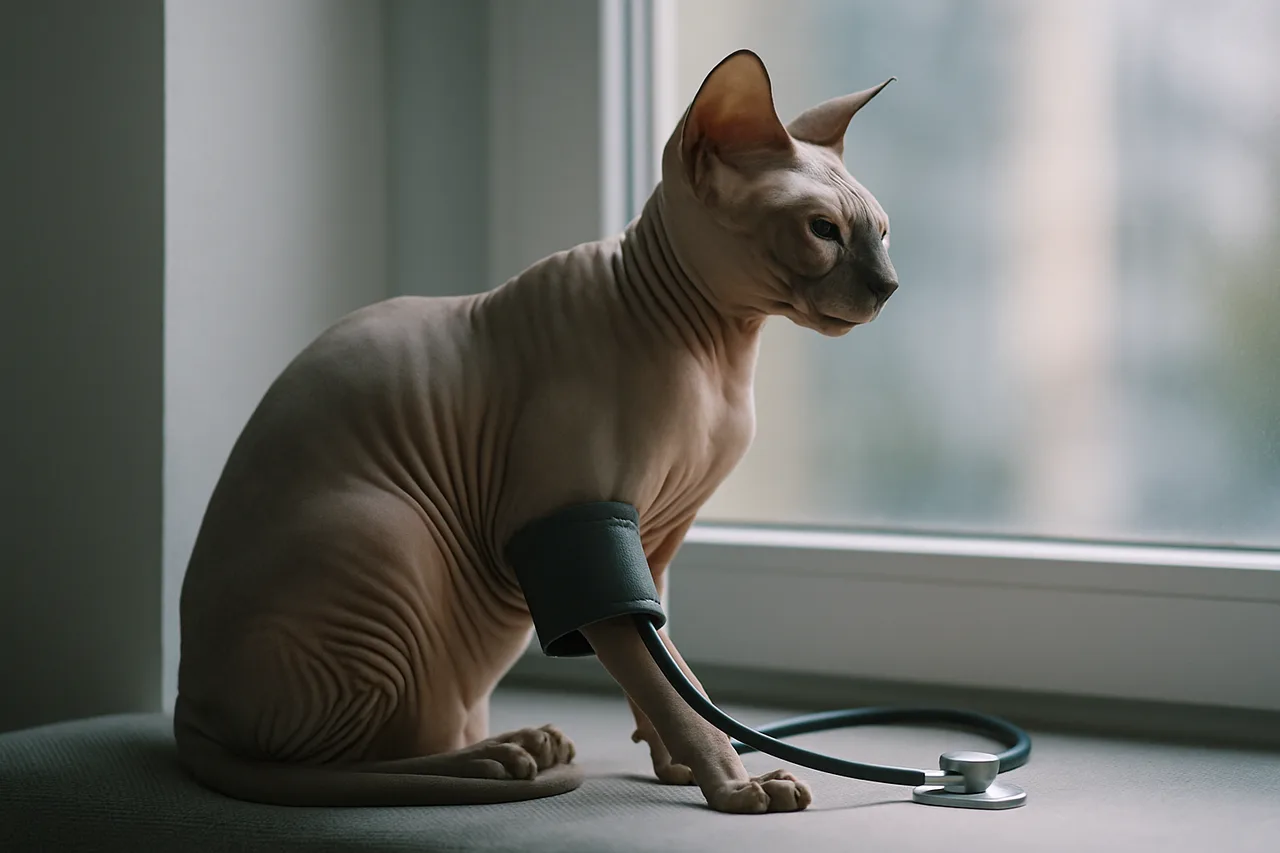
Feline systemic hypertension is a persistent rise in a cat's blood pressure, defined by the ACVIM 2018 consensus as a systolic pressure at or above 160 mmHg associated with risk of target-organ damage. It is called the silent threat because it often produces no signs until it damages the eyes, brain, heart and kidneys, and it is frequently discovered only when a cat goes suddenly blind. That is why measuring blood pressure in cats aged 7 and over is a simple, painless way to protect your cat's health.
Why feline hypertension is silent
A hypertensive cat rarely looks ill. There is no cough, obvious fatigue or clear behavioral decline to alert the owner in the early stages. Blood pressure keeps climbing and the vessels of delicate organs suffer silently, often for months, with no symptom noticeable at home.
Because it is predominantly a disease of older cats, it usually coexists with other age-related conditions, which masks the picture even further. When a sign finally appears, it is usually established target-organ damage, such as sudden blindness. That is why blood pressure measurement should not wait for the cat to become sick: it is a screening tool, not only an emergency diagnostic test.
The most common causes: chronic kidney disease and hyperthyroidism
In most cats, hypertension is secondary, meaning it arises as a consequence of another disease. The two most frequent underlying causes are chronic kidney disease (CKD) and hyperthyroidism, both typical of the older cat. In a large share of hypertensive cats there are signs of chronic kidney disease (in some series, in up to about 74%, per the ISFM consensus), and hypertension is also present in a substantial share of cats with chronic kidney disease.
In hyperthyroidism, some cats are already hypertensive at diagnosis and a further proportion may develop hypertension after the thyroid is treated, which reinforces the need to monitor blood pressure over time rather than just once. A smaller fraction of cases is considered idiopathic, with no identifiable underlying cause, a situation described in roughly 13% to 20% of hypertensive cats. The good news: identifying and treating the underlying disease is central to management. The decision about cause, testing and treatment always rests with the veterinarian.
Target-organ damage: what high blood pressure destroys
When blood pressure stays high for too long, four organs suffer in particular: eyes, brain, heart and kidneys. The eye is the most visible and dramatic. High pressure can cause retinal detachment, hemorrhage and sudden blindness, often the first sign that brings the owner to the clinic. Ocular risk rises with higher pressures, and in many cases vision loss is permanent, although early treatment may reverse part of the damage.
In the brain, hypertension can cause neurological signs such as disorientation, loss of balance, seizures, behavioral change and weakness, described in a relevant proportion of hypertensive cats. In the heart, the pressure overload leads to wall thickening (hypertrophy), detected in a high proportion of cases, with a murmur or gallop rhythm possible on examination. In the kidneys, a dangerous loop closes: CKD can cause hypertension and hypertension worsens CKD, accelerating the loss of renal function.
How blood pressure is classified: the ACVIM 2018 consensus
The ACVIM 2018 consensus organizes a cat's systolic pressure into bands, each carrying a different risk of target-organ damage. This helps the veterinarian decide when to investigate and when to treat, always considering repeated measurements and whether damage is already present.
Systolic pressure bands (risk of target-organ damage): normotensive: less than 140 mmHg, minimal risk · prehypertensive: 140 to 159 mmHg, low risk · hypertensive: 160 to 179 mmHg, moderate risk · severely hypertensive: at or above 180 mmHg, high risk.
The goal of treatment, when indicated, is to lower systolic pressure into a safe range while avoiding hypotension. The ACVIM 2018 consensus works with a hierarchy of targets: the minimum acceptable target is to keep systolic pressure at or below 160 mmHg, while the ideal target is below 140 mmHg, the range associated with the lowest risk of target-organ damage. The choice of medication, targets and monitoring is a clinical decision for the veterinarian.
Why measure blood pressure in cats from age 7
Because the disease is silent and more common in older cats, guidelines recommend building blood pressure measurement into the routine of senior and geriatric felines. In line with the ISFM consensus, senior cats (roughly 7 to 10 years) should have their pressure checked at least every 12 months, and geriatric cats (from 11 years) every 6 to 12 months. Pressure should also be measured whenever there is CKD, hyperthyroidism or any suspicious ocular or neurological sign.
Measurement is quick and painless, performed with a cuff on a limb or the tail, much like in humans. To reduce the effect of stress (so-called white-coat hypertension), the consensus recommends a calm environment, time to acclimate, a cuff width of 30% to 40% of the limb circumference, discarding the first reading and using the average of 5 to 7 consistent measurements. A single high value does not confirm a diagnosis: interpretation always rests with the veterinarian.
What the owner should do
If your cat is 7 years or older, ask your veterinarian to include blood pressure measurement in the check-up. If your cat already has kidney disease or hyperthyroidism, or if you have noticed any sudden change in vision, disorientation or a seizure, seek care without delay, because blindness from retinal detachment can be an emergency. Early diagnosis is the best chance to protect your cat's sight, brain, heart and kidneys.
For the clinic, measuring pressure reliably depends on suitable equipment and a standardized protocol. Blood pressure measurement solutions such as BPScan and BPScan S were designed to make this measurement a simple part of the senior cat's routine. Talk to your veterinarian about blood pressure screening: it is an inexpensive, fast test that can change the outcome.
Sources
- Acierno MJ, Brown S, Coleman AE, et al. ACVIM consensus statement: Guidelines for the identification, evaluation, and management of systemic hypertension in dogs and cats. J Vet Intern Med. 2018;32(6):1803-1822. (2018) PMID 30353952
- Taylor SS, Sparkes AH, Briscoe K, et al. ISFM Consensus Guidelines on the Diagnosis and Management of Hypertension in Cats. J Feline Med Surg. 2017;19(3):288-303. (2017) PMID 28245741
- Feline Systemic Hypertension: Classification and pathogenesis (review). PMC. PMID 21215946
- Hypertension. Cornell University College of Veterinary Medicine, Cornell Feline Health Center.
- Carter J, Irving J, et al. Hypertensive ocular disease in cats: A guide to fundic lesions to facilitate early diagnosis. J Feline Med Surg. 2019. (2019) PMID 30763152
- Feline systemic hypertension. Royal Canin Academy (veterinary).