

Dilated cardiomyopathy (DCM) in dogs: screening the occult phase with ECG, Holter and echocardiography
Dilated cardiomyopathy is the most common heart disease in large-breed dogs and is strongly inherited in breeds such as the Doberman. The occult phase has no signs, yet arrhythmias and dysfunction are already detectable by Holter and echocardiography: why annual screening matters.
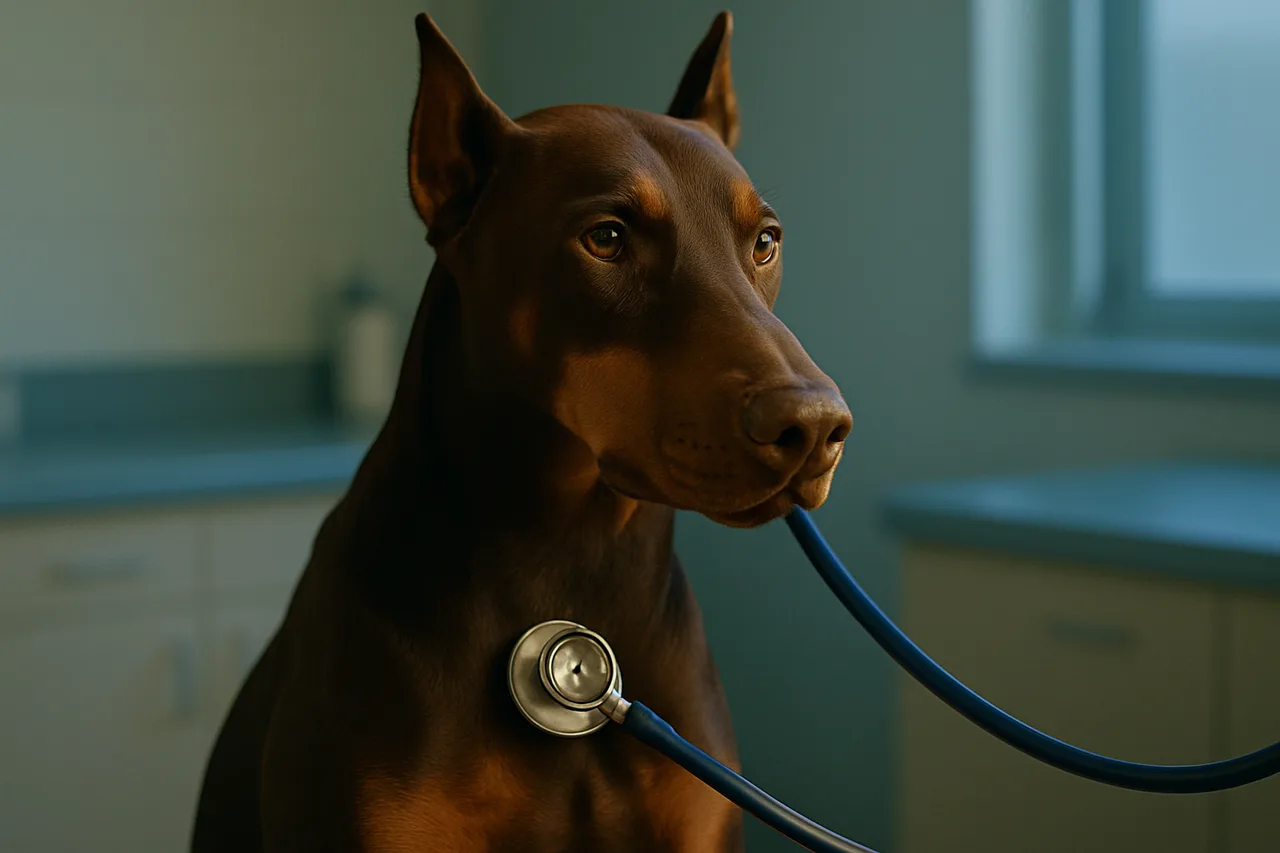
Dilated cardiomyopathy (DCM) is a disease of the heart muscle in which the left ventricle dilates and loses contractile strength, and it is the most common acquired heart disease in large- and giant-breed dogs. It progresses in two phases: an occult (preclinical) phase, in which the heart is already diseased but the dog still shows no signs, and a clinical phase marked by congestive heart failure (CHF), arrhythmias and a risk of sudden death. In high-risk breeds, above all the Doberman, the European Society of Veterinary Cardiology (ESVC) recommends annual screening that combines Holter (24-hour ECG) and echocardiography from a defined age, because the occult phase is detectable only by tests, never by physical examination alone. Interpreting the findings and the therapeutic decision always rest with the veterinarian.
What dilated cardiomyopathy is
In DCM, the myocardial fibers weaken and the left ventricle (often all four chambers) dilates. Because the muscle loses pumping capacity, the heart tends to compensate by dilating even more, which over time lowers cardiac output and congests the circulation. The result is a large heart with thin walls and weak contraction, the opposite of diseases in which the muscle thickens.
In many dogs the main cause is genetic: the disease is inherited and shows a strong breed predisposition. In some cases myocardial dysfunction may be associated with other factors, such as nutritional deficiencies or concurrent diseases, and a portion of those cases may improve when the underlying factor is corrected. Distinguishing primary (genetic) DCM from myocardial dysfunction of another origin is precisely one of the points that requires careful investigation by the veterinary cardiologist.
Predisposed breeds
DCM affects mainly large- and giant-breed dogs. Classically predisposed breeds include the Doberman Pinscher, Great Dane, Boxer, Cocker Spaniel, Irish Wolfhound, Scottish Deerhound, Saint Bernard and Newfoundland, among others. The inheritance pattern and age of onset vary by breed.
The Doberman Pinscher is the most studied example. In a large European cohort study, the disease was described as inherited with an autosomal dominant pattern and a very high cumulative prevalence in the breed, around 58%, rising sharply with age (Wess et al., 2010). In that same study, males tended to show echocardiographic changes earlier, while females had more ventricular premature complexes, which reinforces why screening must look at both the electrical side (Holter) and the structural side (echo).
Occult phase vs clinical phase
The occult (or preclinical) phase is the period in which the heart already shows dilation, reduced contractility or arrhythmias, but the dog still looks healthy to the owner. It is a potentially long and silent phase, and it is exactly here that screening has the most value, because detecting disease before clinical signs widens the window for monitoring and for therapeutic decisions led by the veterinarian.
The clinical phase is when signs appear. It can present in two ways that often coexist: through pump failure, leading to congestive heart failure (cough, breathing difficulty, exercise intolerance, abdominal distension), and through electrical instability, with ventricular arrhythmias that may culminate in syncope or sudden death. In some breeds, above all the Doberman, sudden death can be the first and only manifestation, which makes screening in the occult phase even more relevant.
Clinical signs
When signs appear, they usually reflect the combination of low output and congestion. The most frequent include exercise intolerance and easy fatigue, fast or labored breathing, coughing, weakness, weight loss, episodes of syncope (fainting) and, with systemic congestion, abdominal enlargement from fluid accumulation. These signs are not specific to DCM and require diagnostic confirmation.
From the electrical standpoint, ventricular arrhythmias (ventricular premature complexes, ventricular tachycardia) and, in some large breeds, atrial fibrillation are important findings. They are what underlie the risk of sudden death and often appear before or alongside mechanical dysfunction. Any fainting episode, sudden drop in performance or irregular pulse in an at-risk breed should be assessed by the veterinarian as a priority.
The role of ECG, Holter and echocardiography
Diagnosing DCM rests on two complementary axes: the electrical and the structural. The in-clinic electrocardiogram (ECG) records rhythm in a few minutes and can catch arrhythmias, axis changes and signs of chamber enlargement, but because it is a short window it may miss ventricular premature complexes that occur intermittently across the day.
This is why the Holter (24-hour ambulatory ECG) is the tool of choice for the electrical part of screening: it quantifies ventricular premature complexes (VPCs) over a full day and characterizes ventricular tachycardia, information that is central to estimating risk and detecting the occult phase. The echocardiogram, in turn, assesses the structural side: left ventricular dimensions, systolic function and degree of dilation. Guidelines prefer volumetric methods such as Simpson's method of discs to measure ventricular volume. ECG, Holter and echo do not compete: each sees one face of the disease, and it is their combination that allows the earliest and most reliable diagnosis.
Screening in at-risk breeds: the ESVC guideline
For the Doberman Pinscher, the European Society of Veterinary Cardiology (ESVC) published specific screening guidelines (Wess et al., 2017). The central recommendation is clear: screening for occult DCM should use Holter and echocardiography together, and it should be repeated yearly throughout the dog's life, because a single normal examination does not rule out future development of the disease. In this guideline, screening is recommended to start from 3 years of age.
The guideline also offers quantitative references for the Holter in the Doberman: fewer than 50 VPCs in 24 hours is considered normal, although detecting any VPC is already cause for concern; more than 300 VPCs in 24 hours, or two successive recordings within a year showing between 50 and 300 VPCs, are considered diagnostic of occult DCM in the breed, regardless of the concurrent echocardiographic finding. As ancillary tests (not substitutes for the standard protocol), the guideline mentions cardiac biomarkers (troponin I and NT-proBNP) and a 5-minute resting ECG, useful when the recommended tests are unavailable or not feasible annually. These cut-off values are specific to the Doberman and should not be automatically extrapolated to other breeds; their application and interpretation are up to the veterinarian.
Diet and DCM: what is under investigation, with caution
In recent years a discussion has emerged about a possible association between certain diets (some formulations described as grain-free or legume-rich) and cases of DCM, including in breeds with no known genetic predisposition. It is important to treat this topic with balance: this is an association under investigation, and the veterinary literature has not established a definitive cause-and-effect relationship (Freeman et al., 2018; McCauley et al., 2020).
Reviews of the topic emphasize that controlled studies isolating one variable at a time are lacking, and that many of the early communications were based on reports and pharmacovigilance data subject to bias (McCauley et al., 2020). At the same time, there are case reports of suspected diet-associated DCM that showed improvement in myocardial function and clinical outcomes after a diet change combined with standard medical therapy (Walker et al., 2021). The practical message is prudent: any dietary change in a dog with suspected or diagnosed DCM should be discussed with the veterinarian, ideally with nutrition and cardiology support, and never replaces imaging and Holter diagnosis or the prescribed treatment.
Frequently asked questions
At what age should I start screening my Doberman? For the Doberman Pinscher, the ESVC guideline recommends starting screening from 3 years of age, combining Holter and echocardiography, and repeating it annually, because a normal examination does not guarantee the disease will not appear later (Wess et al., 2017).
Is an in-clinic ECG alone enough? Not for screening occult DCM. A few-minute ECG can catch arrhythmias present at that moment, but it may miss intermittent ventricular premature complexes; this is why the electrical part of screening relies on the 24-hour Holter, always combined with echocardiography to assess structure and function (Wess et al., 2017).
Is DCM curable? There is no cure for the genetic form, but early diagnosis, above all in the occult phase, allows monitoring and veterinarian-led therapeutic decisions aimed at slowing progression and reducing risk. The treatment plan is always individual and defined by the veterinarian.
Sources
- Wess G, Domenech O, Dukes-McEwan J, Haggstrom J, Gordon S. European Society of Veterinary Cardiology screening guidelines for dilated cardiomyopathy in Doberman Pinschers. J Vet Cardiol. 2017;19(5):405-415. (2017) PMID 28965673
- Wess G, Schulze A, Butz V, et al. Prevalence of dilated cardiomyopathy in Doberman Pinschers in various age groups. J Vet Intern Med. 2010;24(3):533-538. (2010) PMID 20202106
- Freeman LM, Stern JA, Fries R, Adin DB, Rush JE. Diet-associated dilated cardiomyopathy in dogs: what do we know? J Am Vet Med Assoc. 2018;253(11):1390-1394. (2018) PMID 30451613
- McCauley SR, Clark SD, Quest BW, Streeter RM, Oxford EM. Review of canine dilated cardiomyopathy in the wake of diet-associated concerns. J Anim Sci. 2020;98(6):skaa155. (2020) PMID 32542359
- Walker AL, DeFrancesco TC, Bonagura JD, et al. Association of diet with clinical outcomes in dogs with dilated cardiomyopathy and congestive heart failure. J Vet Cardiol. 2021;40:99-109. (2021) PMID 33741312