

How to Measure Blood Pressure in Dogs and Cats: The ACVIM 2018 Protocol Step by Step
A practical guide anchored in the ACVIM 2018 consensus: quiet room, acclimation, minimal restraint, cuff selection, positioning, and the average of 5 to 7 valid readings after discarding the first.
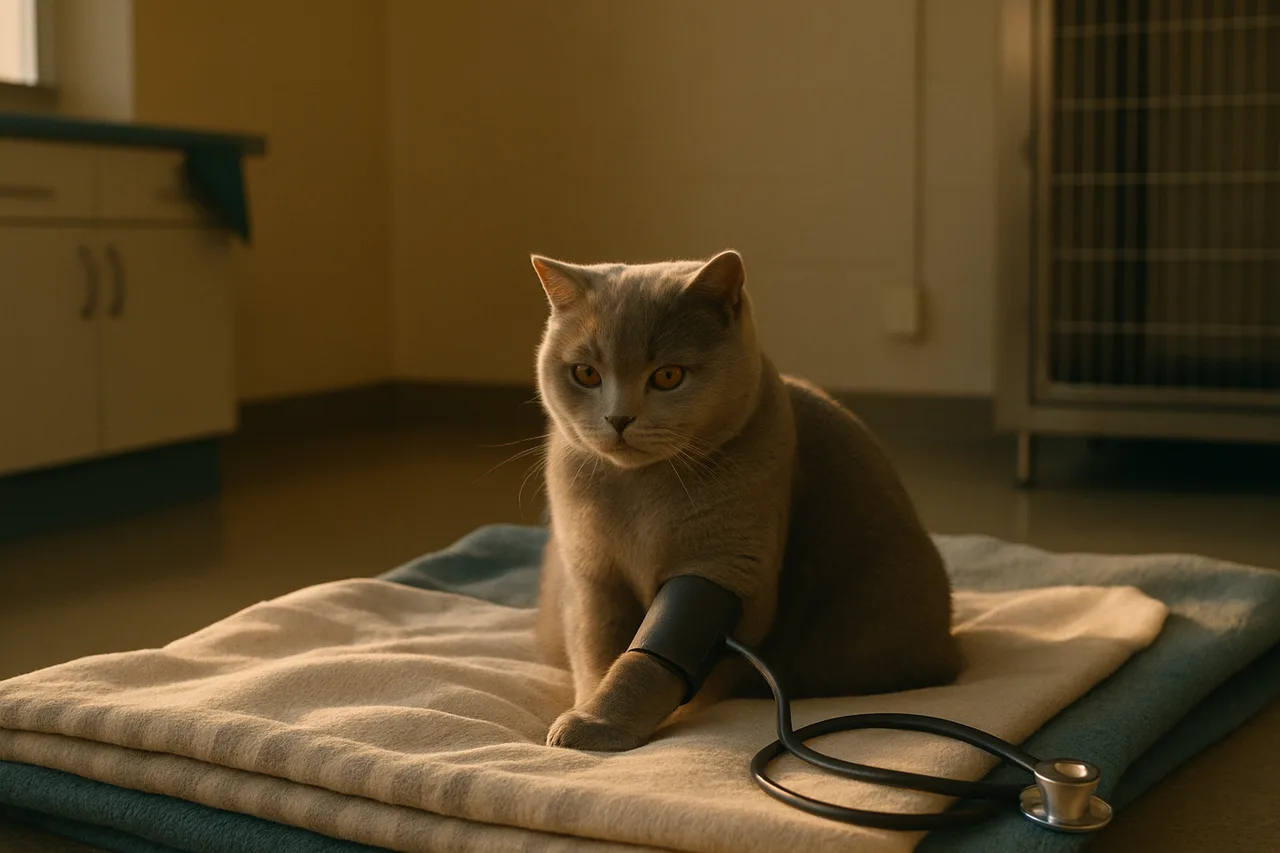
Measuring blood pressure correctly in dogs and cats means following a standardized protocol in which the patient is acclimated to a quiet environment, restrained minimally, and assessed with a properly sized cuff (width equal to 30 to 40% of the limb circumference). According to the 2018 ACVIM consensus, the first reading is discarded and the final result is the average of 5 to 7 consecutive, consistent measurements. This approach reduces situational (white-coat) hypertension and makes the value reliable enough to guide clinical decisions.
Why Technique Matters So Much
Blood pressure is a vital sign sensitive to stress. Anxiety and agitation can raise the reading sharply and unpredictably: some animals react strongly and others barely at all. For this reason, the 2018 ACVIM consensus emphasizes that situational hypertension can be minimized by measuring in a quiet area, away from other animals and before other procedures, after a period of acclimation. There is currently no justification for treating situational hypertension as a disease.
Poorly standardized technique produces values that swing from one visit to the next and lead to mistaken interpretations. Standardizing the environment, the operator, the equipment, and the measurement sequence is what separates a decorative number from useful clinical data. Interpreting the result and any clinical action always remain the responsibility of the attending veterinarian.
Step 1: Quiet Environment and Acclimation
Choose an isolated, quiet room away from other animals. Whenever feasible, keep the owner present, since familiarity helps calm the patient. Before starting, allow the animal to acclimate to the room for 5 to 10 minutes. Measurement should begin only when the patient is calm and motionless.
Ideally, take the reading before any other procedure in the visit, so that handling and examinations do not add stress to the value. This acclimation interval is one of the most effective measures against the white-coat effect.
Step 2: Minimal Restraint and Positioning
Restraint should be kept to the minimum necessary. Position the animal comfortably, ideally in ventral or lateral recumbency, with gentle contact. Avoid forced immobilization, which by itself raises blood pressure.
The height of the cuff relative to the heart base also influences the value. The 2018 ACVIM consensus recommends keeping the vertical distance between the cuff site and the heart base within about 10 cm; when that is not possible, the value can be corrected (approximately 0.8 mmHg per centimeter of difference). Record the patient's position and behavior to reproduce the conditions at future assessments.
Step 3: Cuff Selection and Placement
Cuff selection is the most common technical error. The cuff width should be approximately 30 to 40% of the circumference of the placement site. A cuff that is too narrow overestimates pressure; one that is too wide underestimates it. It is therefore worth measuring the circumference (in cm) with a tape and selecting the cuff objectively, not by visual estimate.
The cuff may be placed on a limb or on the tail, taking into account the animal's conformation, tolerance, and operator preference. Use the device-specific cuffs supplied with the equipment. Always document the chosen site and the size used, so that future measurements are comparable.
Step 4: 5 to 7 Readings, Discard the First, and Average
With the patient calm, take consecutive measurements. The first reading should be discarded, as it tends to be the highest and least reliable. Then obtain 5 to 7 consecutive, consistent values. If there is substantial variation between readings, discard them and repeat the process. If the values are still falling progressively, continue measuring until they stabilize (plateau) before recording the definitive series.
The final result is the average of the valid values. Whenever possible, the same trained operator should perform all measurements, following a single protocol. Operator consistency reduces visit-to-visit variability as much as the choice of equipment does.
Step 5: Record Everything Traceably
Documentation is part of the method. Record the operator's name, the cuff size and site, the site circumference (cm), all values obtained, which ones were excluded and why, the final average, and the interpretation. Also note the animal's position and behavior.
This standardized record makes it possible to compare assessments over time and distinguish a real trend from technical variation. It is also what supports the follow-up of patients at risk of target-organ damage.
How to Interpret the Values (ACVIM Categories)
The 2018 ACVIM consensus classifies the risk of target-organ damage based on systolic blood pressure: normotensive below 140 mmHg (minimal risk), prehypertensive 140 to 159 mmHg (low risk), hypertensive 160 to 179 mmHg (moderate risk), and severely hypertensive at 180 mmHg or above (high risk). Sight hounds and related breeds may have higher baseline values, calling for caution in interpretation.
These thresholds assume a measurement taken with correct technique. A single value, outside protocol, does not establish a diagnosis of hypertension: the consensus recommends confirming elevated findings on more than one occasion, according to the clinical picture. The clinical decision is always made by the veterinarian.
Common Errors That Invalidate the Measurement
The most frequent slips are predictable: skipping acclimation, restraining the animal forcefully, choosing the cuff by eye (outside the 30 to 40% circumference range), failing to discard the first reading, recording fewer than 5 measurements, and changing operators between visits. Each of these factors introduces systematic error.
The good news is that all of them are avoidable with protocol discipline. Standardizing the technique, using equipment validated for the species, and keeping the same operator turn blood pressure measurement into reproducible data, capable of supporting clinical follow-up over time.
Sources
- Acierno MJ, Brown S, Coleman AE, et al. ACVIM consensus statement: Guidelines for the identification, evaluation, and management of systemic hypertension in dogs and cats. J Vet Intern Med. 2018;32(6):1803-1822. (2018) PMID 30353952
- ACVIM consensus statement: Guidelines for the identification, evaluation, and management of systemic hypertension in dogs and cats (full text, PMC). (2018) PMID 30353952
- Comparison of Doppler ultrasonic sphygmomanometry, oscillometry and high-definition oscillometry for non-invasive blood pressure measurement in conscious cats. (2024) PMID 38546192